

What Public Companies should be doing now to prepare for the data, process, control, and disclosure challenges ahead
In November 2024, the FASB issued ASU 2024-03, Disaggregation of Income Statement Expenses, commonly referred to as DISE. The standard is intended to provide investors with more detail about the expenses included in income statement captions such as cost of sales, selling, general and administrative expenses, and research and development. This added detail is meant to help investors better understand company performance, assess future cash flows, and make comparisons across companies and reporting periods.
At first glance, DISE may appear to be a footnote disclosure exercise. For many public companies, however, implementation will likely require much more than drafting a new table at year-end. Systems, charts of accounts, consolidation processes, data models, disclosure procedures, and internal controls must all be able to support the required expense detail consistently. Preparing the table is only one part of the work. The underlying data, processes, judgments and controls will determine whether the disclosure can be produced accurately and efficiently.
What DISE Requires
ASU 2024-03 applies only to public business entities. For calendar-year public companies, the new disclosures will first apply to the 2027 Form 10-K filed in early 2028. Interim period disclosures will begin with the Form 10-Q for the first quarter of 2028.
The core requirement is that companies include a table in the footnotes that disaggregates each “relevant expense caption” presented on the face of the income statement within continuing operations into specified natural expense categories. These categories include purchases of inventory, employee compensation, depreciation, intangible asset amortization, and depreciation, depletion, and amortization recognized as part of oil-and-gas producing activities, or other depletion expense, as applicable. A relevant expense caption is an expense caption on the face of the income statement within continuing operations that contains one or more of those required categories.
Companies must also include certain amounts already required to be disclosed under existing GAAP in the same tabular disclosure, provide qualitative descriptions of residual “other” amounts, and disclose total selling expenses. In annual periods, companies must also disclose how they define selling expenses.
Why Implementation May Be Harder Than It Looks
Many companies do not currently manage or report expenses in the form required by DISE. Expenses may be presented by function, such as cost of revenue, research and development, or SG&A, while DISE requires natural expense categories to be identified within those captions. Producing that information may involve mapping data across general ledger accounts, cost centers, subledgers, reporting packages, consolidation systems, and spreadsheets.
Inventory-related expense captions can add another layer of complexity. For relevant expense captions containing inventory-related amounts such as cost of goods sold, companies will need to determine whether to present disaggregation on a cost-incurred basis or an expense-incurred basis. That decision is not merely a formatting choice; it can affect data requirements, reconciliation schedules, inventory rollforwards, foreign currency considerations, acquisition impacts, standard costing effects, and related controls.
DISE also requires judgment. Companies will need to identify all relevant expense captions, determine how required natural expense categories map to source data, define selling expenses, develop supportable descriptions for residual “other” categories, and determine how existing GAAP disclosure amounts should be integrated into the new table. Those judgments should be documented and applied consistently across reporting periods.
Controls and Audit Readiness Should Be Addressed Early
Because DISE applies to both annual and interim periods, the reporting process must operate within a quarterly close schedule. A process that works during the year-end close may not be practical when reporting deadlines are shorter.
Internal controls should address the completeness of relevant expense captions, the accuracy of expense mappings, the consistent application of accounting and presentation decisions, and the reconciliation of inventory amounts and other reconciling items. Companies will also need review controls over the preparation of the disclosure.
For companies that rely heavily on manual processes, spreadsheets, multiple ERPs, recent acquisitions, international operations, or complex allocation methodologies, the control environment may need to evolve. Ownership, preparer and reviewer evidence, management approval, and auditor-facing support should be designed before adoption, not after a disclosure draft has already been prepared.
A Practical Roadmap for Adoption
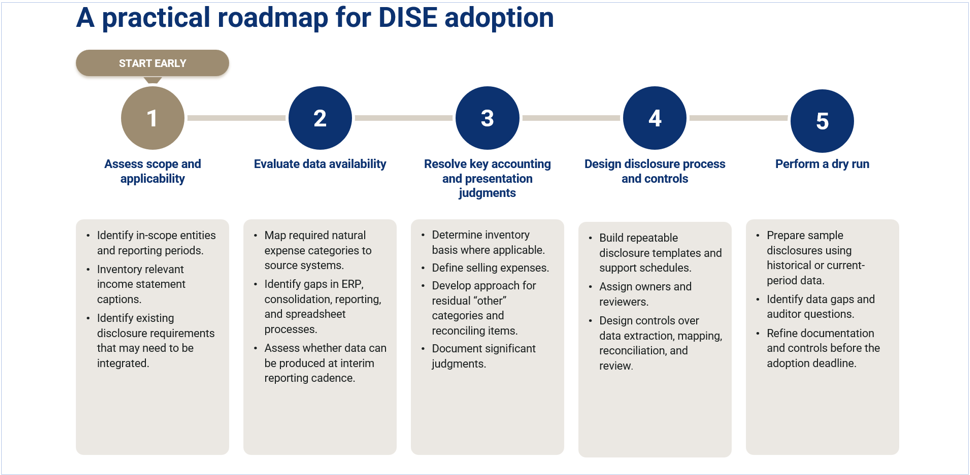
Companies can reduce implementation risk by treating DISE as a structured adoption project. A practical roadmap includes:
- Perform a dry run. Prepare sample disclosures using historical or current-period data, identify data gaps and auditor questions, and refine documentation and controls before the adoption deadline.
- Assess scope and applicability. Identify in-scope entities and reporting periods, inventory income statement captions, and determine which existing disclosures may need to be integrated into the DISE table.
- Evaluate data availability. Map required natural expense categories to source systems and assess whether ERP, consolidation, reporting, and spreadsheet processes can produce the information at annual and interim cadence.
- Resolve key accounting and presentation judgments. Determine the inventory basis where applicable, define selling expenses, develop an approach to residual “other” categories and reconciling items, and document significant judgments.
- Design the disclosure process and controls. Build repeatable templates, assign owners and reviewers, and design controls over data extraction, mapping, reconciliation, and review.
How WilliamsMarston Can Help
WilliamsMarston can help companies move from understanding the technical requirements to implementing a repeatable, controlled, and audit-ready disclosure process. Our teams can assist with technical accounting assessments, identification of relevant expense captions, documentation of key judgments and policy decisions, data and process diagnostics, disclosure templates, support schedules, management review packages, control design, and auditor-facing documentation.
DISE adoption is manageable, but companies should start early. Those that begin now will be better positioned to make thoughtful policy decisions, identify data gaps, avoid manual reporting workarounds, and reduce late-stage reporting pressure when the new requirements become effective.


