

The One Big Beautiful Bill Act (the “OBBBA”)[1] made an already-powerful tax benefit meaningfully more attractive. For decades, section 1202[2] has allowed founders and early investors to exclude a large portion, often all, of the gain on the sale of qualified small business stock (“QSBS”). The OBBBA expanded both who can qualify and how much gain can be excluded. For business owners who have built valuable technology alongside a professional services practice, that expansion creates a tax planning opportunity worth understanding.
I. Background on Section 1202: Statutory Regime and Enhancements
Section 1202 was enacted in 1993 to encourage investment in small business by allowing noncorporate shareholders to exclude a portion of the gain realized on the sale of qualifying stock in a domestic C corporation.[3] Since then, the section 1202 regime has been amended multiple times to be more generous and flexible, with the goal being to stimulate small business investment.
Most recently, the OBBBA introduced a tiered exclusion for QSBS issued after July 4, 2025, based on holding period, which allows a selling QSBS shareholder to exclude (up to a cap) (i) 50 percent of the gain on stock held for three years, (ii) 75 percent of the gain on stock held for four years, and (iii) 100 percent of the gain on stock held for five (or more) years.[4] The OBBBA also raised the per-taxpayer gain exclusion cap from $10 million to $15 million and increased the aggregate gross assets threshold from $50 million to $75 million, with inflation adjustments beginning after 2026.[5] The last change broadens the universe of businesses that can issue QSBS, including some that were previously too large to qualify.[6]
The size of the tax benefit is worth appreciating. The per-issuer exclusion is the greater of $15 million or ten times the shareholder’s aggregate adjusted basis in the stock. Where a founder contributes property, rather than cash, to the corporation in exchange for stock, the basis used for the ten-times-basis cap is the fair market value of the contributed property, which can substantially enlarge the excludable amount for a technology company seeded with valuable IP.[7] It is also worth noting that the section 1202 exclusion represents a permanent tax benefit, rather than a deferral or timing benefit; that is, the gain excluded under section 1202 is never subject to taxation.
To qualify as a small business under section 1202, at least 80 percent of the corporation’s assets, by value, must be used in the active conduct of one or more qualified trades or businesses throughout substantially all of the holding period. Notably, certain service-based businesses are excluded, including accounting, law, health, financial services, brokerage, consulting, and any business whose principal asset is the reputation or skill of one or more employees.[8] That exclusion is why a pure services firm generally cannot issue QSBS. Conversely, genuine technology businesses can potentially qualify, including technology businesses that provide solutions for service-based businesses.
This insight explores whether the benefits of section 1202 can extend to technology-intensive businesses that have historically been operated as a component part of a broader, disqualified service-based business. Whether that separation ultimately works is a facts-and-circumstances question.
II. The Opportunity: Separating a Technology Function
As software, data, and AI tools become embedded in traditionally people-driven service businesses, the line between a services firm and a technology company has blurred. Where a business has a genuine, transferable technology component that is not solely tied to the underlying services, there may be an opportunity to house the technology component of the business in a separate legal entity, that standing alone, can operate a qualifying business within the meaning of section 1202.
In the envisioned structure, the professional services operation would sit in one entity (“Service Co.”), while software, AI tools, codebases, and other intellectual property are developed and owned by a separate C corporation (“IP Co.”). IP Co. licenses the technology to Service Co. on an arm’s-length basis. IP Co. also licenses the technology to unrelated third parties. The diagram below depicts the envisioned structure.
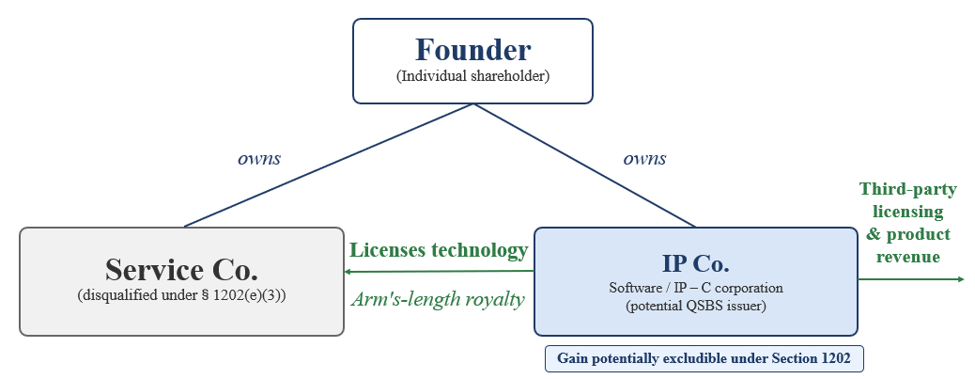
Figure 1. The IP Co. / Service Co. structure. The founder owns both entities; IP Co. licenses technology to Service Co. on arm’s-length terms and, ideally, to unrelated third parties. Only IP Co. stock is positioned for QSBS treatment.
The business rationale for separating the functions in distinct legal entities can be sound. A services firm typically grows through professionals, clients, and billable hours. A software business scales differently, through licenses, subscriptions, and product adoption. The employees operating IP Co. will have a distinct skill set versus the employees operating Service Co., and each company’s management teams will have different experiences. If IP Co. owns and develops technology that can be commercialized independent of Service Co., then the business operated by IP Co. would have genuine substance as its business objectives would not be tied to the efforts of Service Co.’s employees and IP Co.’s value would not derive entirely from success or failure of Service Co.
III. Is IP Co. a Qualified Trade or Business?
The threshold question is whether IP Co.’s activities constitute a qualified trade or business under section 1202(e)(3). The premise for the structure is based on IP Co. being a real technology company, not a company operating in a distinct service-based industry like health, law, engineering, architecture, accounting, actuarial science, performing arts, consulting, athletics, financial services, etc.[9] It maintains a separate legal identity, employs software developers and engineers, owns and develops proprietary technology, and incurs research or experimental expenditures under section 174.[10] IP Co.’s value derives from proprietary software and intellectual property rather than from its employee’s personal reputation, or professional judgment, expertise, or certification. If the technology has standalone utility, can be licensed to unrelated customers, and is not merely an internal tool for Service Co., IP Co. has the elements of a distinct and real business, not an ancillary or administrative activity performed in connection with the service-based business.[11] Further, IP Co’s business would need to be operated throughout substantially all of the relevant taxpayers holding period, with at least 80 percent of the corporation’s assets, by value, used in the active conduct of one or more qualified trades or businesses.[12] Practically, IP Co.’s assets should remain devoted to technology development and commercialization throughout the holding period, and IP Co. should not drifts toward disqualified services. Based on the above, it could reasonably be asserted that IP Co. performs a specific group of activities for purposes of earning income or a profit and the activities include every operation that forms a part of, or a step in, the process of earning income or profit.[13]
While not precedential, recent private letter rulings illustrate how the IRS distinguishes a technology business from a disqualified services business.[14] In PLR 202144026,[15] the IRS concluded that a software company serving the healthcare industry was engaged in a qualified trade or business, even though its software was used by providers in treatment decisions, because the company did not itself practice medicine, diagnose patients, or provide medical advice. In PLR 202418001,[16] a company providing medical testing services and reports likewise qualified where it did not treat or diagnose customers. In PLR 202342015,[17] a company providing data migration, cloud transformation, and managed technical services was not engaged in disqualified consulting, because its limited advice was ancillary to implementing and managing technology solutions.
The common thread of these authorities is that the IRS is focused on the essence of the business’s core functions, not the industry of its end users. A company is not a disqualified services business simply because doctors, accountants, or consultants use its technology. The more relevant question is whether the company performs the disqualified services itself or instead develops technology and tools that others use. If the technology merely captures the Service Co.’s core functions and has no meaningful use outside Service Co., then it would be difficult to assert that IP Co’s principal assets are unrelated to the skill or reputation of the Service Co. employees. Moreover, if IP Co. does not have demonstrably separate activities then it would also be difficult to ascribe meaningful value to IP Co. at exit, which would blunt the tax benefit of section 1202.
IV. Anti-Abuse Considerations
Section 1202(k) gives Treasury broad authority to issue regulations “to prevent the avoidance of the purposes of [section 1202] through split-ups, shell corporations, partnerships, or otherwise.” However, Treasury Regulations under section 1202(k) have not been issued. However, it is notable that Treasury and the IRS included section 1202 on the 2025-2026 Priority Guidance Plan, signaling that this is an active guidance area following the OBBBA.[18]
While the scope of section 1202(k) is unclear, it would not seem appropriate to apply this anti-avoidance rule to an IP Co. / Service Co. structure that has bona fide business rationale, even if a consideration of the structure is tax optimization.[19] Presumably, any future guidance under section 1202(k) would be aimed at aggressive multiplication structures, such as dividing a single business among many corporations purely to multiply the per-issuer exclusion, rather than at a genuine separation of a technology business from a services business. A technically compliant structure may also have to withstand broader anti-abuse principles.[20]
V. Practical Indicators That May Determine the Outcome and Other Considerations
Drawing on the statute, the ruling authorities, and general anti-abuse doctrines, the following factors tend to support or undermine section 1202 qualification as follows:
| Facts That Support QSBS Treatment | Facts That Undermine It |
| Third-party licensing revenue and relationships with unrelated customers. | No meaningful third-party revenue; the software is used only by Service Co. |
| Software has standalone utility and can be marketed independently of Service Co. | Value derives from the Service Co. employees’ reputation, professional expertise, professional certifications, or client relationships. |
| Dedicated software developers and engineers employed directly by IP Co. | Employees are routinely shared with Service Co.; little development occurs within IP Co. |
| Separately tracked section 174 research and experimental expenditures. | Minimal or no research or development activity within IP Co. |
| Ownership of proprietary source code, algorithms, patents, or copyrights. | The software merely captures the Service Co.’s internally developed procedures and services in digital form. |
| Arm’s-length, documented royalty arrangements supported by a valuation. | Arbitrary or non-commercial related-party royalties designed to shift income. |
| Separate books, bank accounts, governance, and management. | Commingled operations, shared governance, and no independent recordkeeping. |
| A credible non-tax business purpose, such fit and focus, IP protection, or to facilitate more appropriate/measure allocations of capital. | The separation is solely to achieve the exclusion under section 1202 |
It is important to note that the separate structure is not without potentially adverse side effects. For example, operating both businesses in a single legal entity or group of affiliated entities may be simpler from an operational and compliance perspective. Separate legal entities could introduce incremental costs and complexity, and even incremental tax friction in the pre-exit years. Moreover, there would likely be limitations on the ability to move into the IP Co. / Service Co. structure in anticipation of a sale or exit. Therefore, the immediate costs would have to be weighed against the eventual tax benefit at exit.
VI. Key Takeaways and How WilliamsMarston Can Help
As a result of the changes to section 1202 under the OBBBA, QSBS planning has become more accessible and valuable. Simultaneously, as businesses become more technology intensive and develop through the implementation of AI, there is the potential to see bona fide technology businesses expand out of historical service-based operations.
WilliamsMarston’s tax professionals regularly assist companies and investors in navigating the complexities of section 1202. Our experience spans the full lifecycle of QSBS planning, from entity formation and initial capitalization through financings, acquisitions, restructurings, and exit transactions. We help clients assess qualification requirements, document support for QSBS status, evaluate the impact of future corporate actions on eligibility, and identify opportunities to preserve and maximize the section 1202 exclusion.
[1] H.R. 1, P.L. 119–21.
[2] Unless otherwise indicated, all “section” references are to the Internal Revenue Code of 1986, as amended (the “Code”), and all “Treas. Reg.” references are to the Treasury regulations promulgated thereunder.
[3] H.R. Rep. No. 103-111, at 600-03 (1993); Section 1202.
[4] Section 1202(a), as amended by the One Big Beautiful Bill Act, Pub. L. No. 119-21.
[5] Section 1202(b), (d), as amended by Pub. L. No. 119-21. See also Stephen Marencik and Scott Masaitis, Qualified Small Business Stock after the One Big Beautiful Bill Act, WilliamsMarston Insights (July 9, 2025), https://williamsmarston.com/insights/qualified-small-business-stock-after-the-one-big-beautiful-bill-act/.
[6] For a related discussion of QSBS as an ongoing documentation discipline, see Stephen Marencik and Scott Masaitis, Strategic Tax Planning in 2026: IPOs, Mergers and Acquisitions, Financing and Disposition Planning, WilliamsMarston Insights (Jan. 26, 2026), https://williamsmarston.com/insights/insights-2026-year-begining-tax-considerations.
[7] Section 1202(b)(1). Where property is contributed to the corporation in exchange for stock, section 1202(i)(1)(B) treats the shareholder’s basis, for purposes of the ten-times-basis cap, as the fair market value of the contributed property at the time of the exchange.
[8] Section 1202(e)(1)(A), (e)(3)(A). Among other requirements, the corporation must also satisfy the aggregate gross assets test (section 1202(d)(1)) and the original issuance requirement (section 1202(c)(1)(B)).
[9] Other excluded businesses include, banking, insurance, financing, leasing, investing, farming, as well as any business operating a hotel, motel, restaurant, as well as other similar businesses.
[10] Section 1202(e)(2)(B) specifically treats assets used in activities resulting in section 174 expenditures as assets used in the active conduct of a qualified trade or business.
[11] IP Co. should also be operated as a legally separate enterprise. Indicia of a separate enterprise could include separately issued and separately determined employee compensation plans, and a separate and distinct borrowing and financing structure. No single factor is dispositive; these are factors weighed in the aggregate and the fact that there may be some shared services or function is not necessarily fatal.
[12] Section 1202(c)(2)(A), (e)(1)(A). The statute does not precisely define “substantially all,” and the 80 percent asset test is best treated as a useful reference point rather than a formal safe harbor for the holding-period requirement.
[13] While not directly applicable, Treas. Reg. § 1.355-3(b)(2)(ii) and the other authorities under section 355 may be used by analogy for an assessment of what constitutes a separate business. Those authorities focus on whether the business has its own employees performing active and substantial managerial and operational functions, and its own receipts and expenses. The authorities under section 355 also recognize that a business can emerge from a previously commingled enterprise and still be respected as separate if the separated business, standing alone, has its own substance. Therefore, the fact that IP Co. technology was developed within or alongside Service Co. should not, by itself, be fatal provided that the business ultimately operated by IP Co. has separate employees and operating activity, third-party revenue, and commercial arrangements that are consistent with how independent businesses operate.
[14] See Section 6110(k)(3).
[15] Aug. 10, 2021.
[16] Feb. 2, 2024.
[17] July 24, 2023.
[18] Dept. of the Treasury & IRS, 2025-2026 Priority Guidance Plan (Sept. 30, 2025) at 2.
[19] Section 1202 itself is a Congressionally sanctioned tax benefit and it would be inappropriate to prevent a taxpayer from structuring its business to avail themselves of that benefit.
[20] For example, section 269 allows the IRS to disallow benefits where control of a corporation is acquired principally to avoid federal income tax, and the economic substance doctrine requires a meaningful change in the taxpayer’s economic position together with a substantial non-tax purpose. Common-law substance-over-form and step-transaction principles may also apply. See also Section 7701. Further, a structure that is set up through a tax-free spin-off under sections 355 and section 368(a)(1)(D) would have to satisfy certain requirements, including a business purposes requirements and other restrictions and limitations on an intended or planned sale or exit.


